

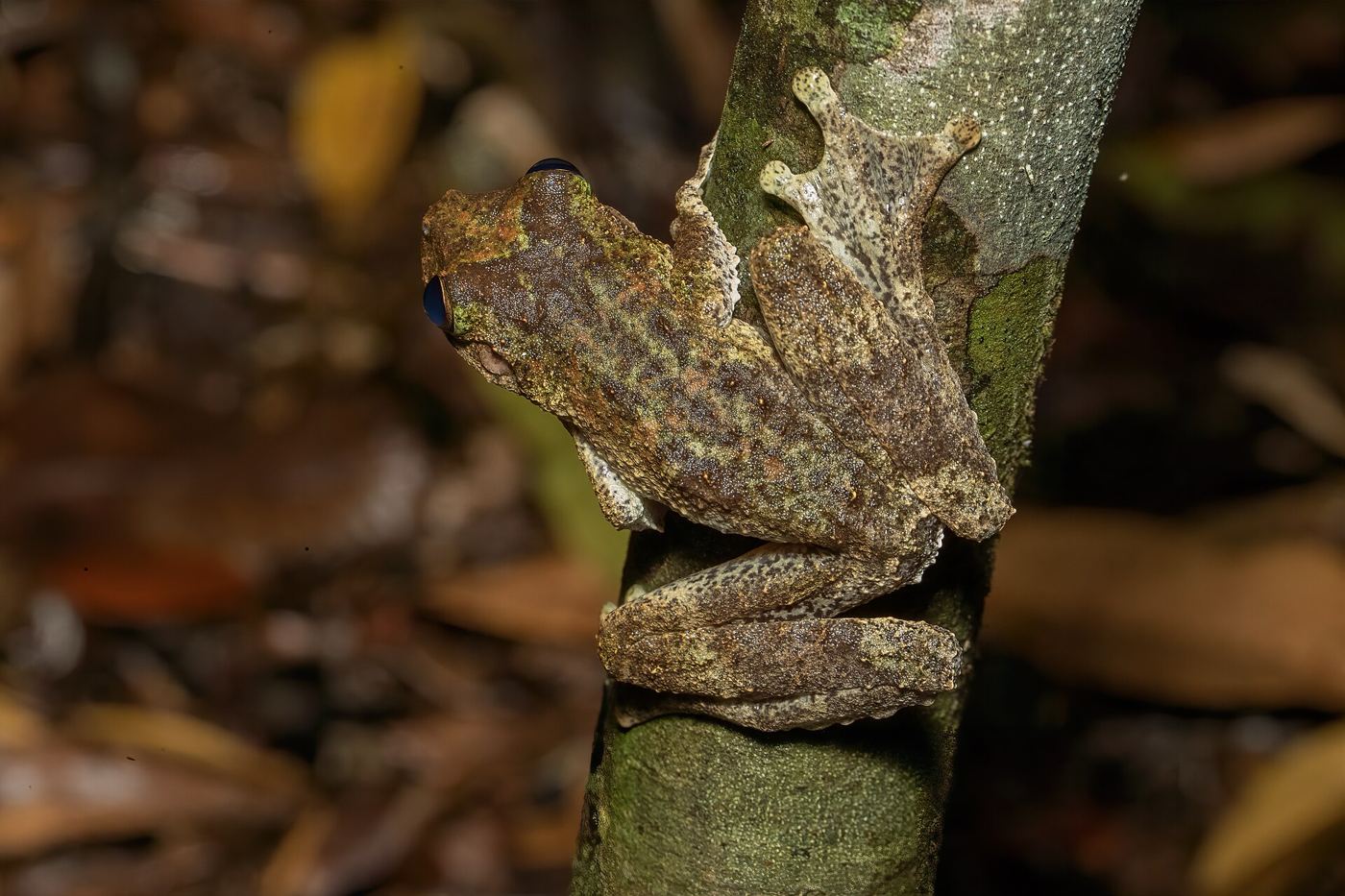
A bright green flying frog discovered in the mountains of Sulawesi, Indonesia, lays its eggs in jelly-like masses instead of the foam nests used by many of its relatives. The species, named Rhacophorus kurniatiae, was formally described on 11 November 2026 in the journal Zootaxa. It was found during biodiversity expeditions between 2009 and 2013, when an Indonesian-American team trekked through the Mekongga Mountains of Southeast Sulawesi. More than 1,860 metres above sea level, at a small seasonal lake called Danau Coca-Cola, the team found thousands of bright green frogs gathered around the water. The discovery was led by Wahyu Trilaksono of Museum Zoologicum Bogoriense in Indonesia, and the species honours the late Indonesian herpetologist Hellen Kurniati.
What the Evidence Shows
Instead of producing frothy foam nests, the frog deposits its eggs in irregular, transparent gel on vegetation above or close to water, where embryos and tadpoles develop inside the gelatinous material. The unusual breeding behaviour is helping researchers understand how much biodiversity remains undocumented in Sulawesi’s mountains. Flying frogs glide between trees using webbed feet, and this species adds a new piece to the island’s amphibian puzzle. Its discovery shows that even well-explored groups can still hold surprises, and it underlines why mountain rainforests in Indonesia deserve protection before their hidden species are lost. The expeditions that found it took place more than a decade ago, showing how long careful fieldwork can take to reach publication. Reporting and analysis from sources such as Nature track the same developments, and specialists following the Sulawesi flying frog discovery say the direction is now consistent across independent lines of evidence.
The Wider Context
The wider context is a research landscape in which replication and open data now decide reputations. Findings connected to the Sulawesi flying frog discovery are being checked by independent groups with shared datasets, and the teams involved publish their methods in full so rivals can test every step. That discipline is slower than a headline cycle, but it is why results in this area increasingly survive first contact with scrutiny.
What Happens Next
What happens next in the story of the Sulawesi flying frog discovery will be decided by follow-up work already under way: larger samples, longer observation and instruments that have not yet come online. The researchers involved are unusually united on one point, that the current results justify the next investment of time and money. Readers will not have to wait long for the first tests of that claim. You can follow related developments in our coverage of science.
None of this will be settled by a single announcement, study or product launch. The pattern to watch is accumulation: independent confirmations, honest reporting of failures and steady improvement in the underlying numbers. Readers who follow those signals, rather than the loudest claim of the week, will understand this subject better than most of the commentary surrounding it suggests is possible.
